


Japan’s Giken Ltd. is developing advanced infrastructure support technologies that are making structures and cities around the world safer and more resilient against natural disasters.
As society becomes more urbanized, we face a growing need for preventive infrastructure that resists deterioration and minimizes damage from natural disasters. One method for stabilizing structures that has been used for centuries is the pile, a long support made of wood, concrete or steel driven deep into the ground.
By reaching far below the surface, piles gain strength and stability directly from the earth, enabling them to support massive loads, resist shifting during earthquakes, withstand the impact of tsunami and hold back rising floodwaters. Today they play an important role in building skyscrapers, earthen retaining walls, levees and other structures.
Unfortunately, the traditional method of driving piles into the ground has some drawbacks. The repeated impacts and vibrations during the process produce a tremendous amount of noise and can be dangerous for workers and nearby residents, limiting how closely work can be done to existing structures. The machinery used for this process also takes up a large amount of space, making it impractical for certain applications.
During Japan’s period of rapid economic growth, Kochi-based Giken was looking for new solutions. In 1975, they announced the development of the hydraulic pile press-in and extraction machine Silent Piler, the first practical application of the press-in principle.
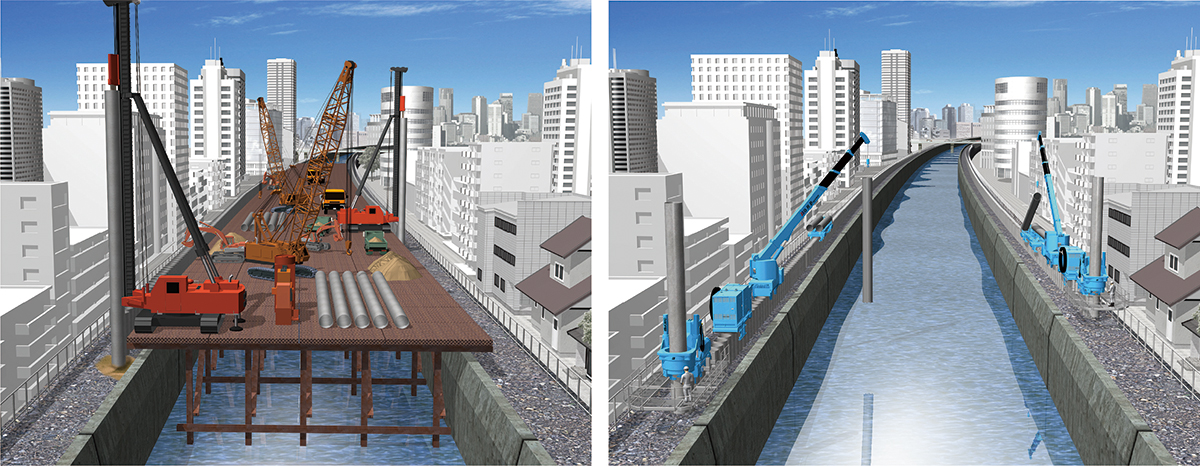
With this system, the Silent Piler attaches to several piles that have already been installed and uses them to stabilize itself while pressing the next pile into the ground using hydraulic force. Because of the strength of the resistance pressure exerted by the earth onto the installed piles, the Silent Piler can apply over 100 tons of force despite its compact size and light weight. This innovative approach became known as the press-in method.
One of the main advantages of the press-in method is that noise and vibrations are almost eliminated, reducing disturbances to nearby residents. The Silent Piler unit is also much smaller than traditional pile drivers, allowing construction to be carried out much closer to existing structures.
This smaller footprint helps to lower costs by eliminating the need to build temporary working platforms and redirect traffic, as well as allowing multiple units to operate at the same time. Because the press-in method allows pile installation to be precisely controlled, complex pile arrangements are possible, and crews can continuously monitor soil and pile conditions to ensure quality and precision placement.
Taking advantage of the improved precision, Giken has developed a wide range of piling methods to meet diverse site requirements. These include methods for working in restricted spaces, around existing structures and in difficult ground conditions such as hard soil and rock layers. As a result, the press-in method can now be applied in a variety of projects that would have been challenging using conventional piling methods.
To overcome the challenges of installing steel tubular piles into hard ground, Giken developed the Gyropress Method, which uses the Gyro Piler. Operating on the same principle as the Silent Piler, it also incorporates a rotating mechanism and a bit at the end of the pile to cut through rock or concrete. This allows new supporting piles to be installed without needing to dismantle existing structures. Together with crane and transport units designed to work on top of existing piles, they are part of the Giken Reaction Base System designed to work quickly and compactly.
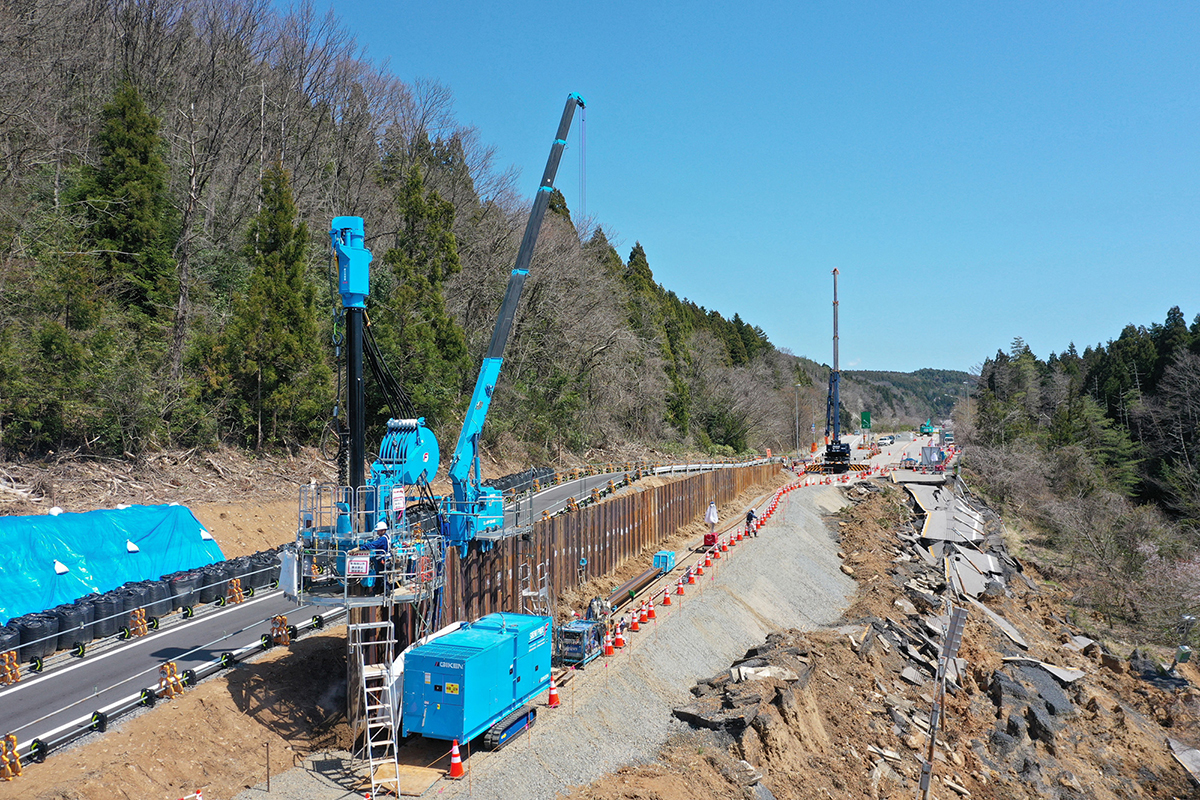
The speed and smaller footprint have made Giken’s innovations invaluable during disaster recovery. Following the 2024 Noto Peninsula earthquake, earthen retaining walls needed to be built so that a collapsed section of the Noto-Satoyama Kaido expressway could be reopened. Silent Piler units were used to quickly secure the area for reconstruction while allowing traffic to flow. The units were also used to repair quays and seawalls in the region’s many fishing ports.
Giken is one of the only developers in the world of hydraulic press-in piling technology, earning global trust for its expertise and a market share of over 90%. Its methods have been adopted at sites in over 40 countries. Giken has recently become involved in a project in the Netherlands to renovate the quay walls of the Canal Ring Area of Amsterdam, a historic neighborhood and UNESCO World Heritage Site.
The existing wooden piles, placed over 100 years ago, were eroding to the point of collapse. The canals are surrounded by dense residential neighborhoods, with homes adjacent to the water, making traditional pile-driving methods impossible without disrupting traffic and risking damage to historic structures.
Working with Dutch contracting firms, Giken was able to demonstrate the superior performance of its GRB System, which eliminated the need for temporary piers. Following the successful 2023 pilot work of replacing over 200 meters, a further 3.3 kilometers is planned through 2032, and the press-in method is expected to become the standard for renovating another 200 km of quay walls.
Based on this success in the Netherlands, Giken is being contacted for projects across Europe, including levee reinforcement in Italy and flood control measures in the U.K. and Germany.
For more information, please visit

