


The Sasakawa Peace Foundation, which addresses issues facing the international community and undertakes initiatives toward achieving peace, marked its 40th anniversary on Sept. 1. The world now faces wars, climate change and disasters. The question we face is how to achieve peace in a world where uncertainty has increased. Atsushi Sunami, the president of the Sasakawa Peace Foundation, and Shigeru Ban, an architect who engages in relief activities in disaster-stricken areas around the world, both worked on a pavilion themed on the sustainable use of marine resources at the Osaka-Kansai Expo in 2025. In this article, they discuss the path to building peace from a private-sector perspective while also considering issues both at home and abroad.
What private bodies can do
What kind of initiatives are you undertaking in the current situation of the international community, where wars, conflicts and disasters continue?
Atsushi Sunami: The Sasakawa Peace Foundation is committed to addressing various issues of the world. We conduct independent research and analysis, and work on projects to address them. This year, we established the Center for Mediation Support to serve as a private-sector body to support peace processes through dialogue and mediation, as conflicts are increasingly complex and prolonged in various parts of the world. The center participates in peace processes even when conflicts are still underway, and its main target regions are Southeast Asia, South Asia and West Asia. We visit the actual sites many times and work with those directly involved and local communities to address the issues.
Shigeru Ban: On my part, I have offices in Tokyo, Paris and New York, where I work as an architect. My work includes designing cultural, commercial and educational facilities and residential homes in different parts of the world. At the same time, I have served as the head of the nonprofit organization Voluntary Architects’ Network, the role in which I have engaged in activities to provide shelters, temporary housing and religious facilities to evacuees in areas hit by disasters. Our current activities include providing emergency assistance to Venezuela and Kumamoto after they were hit by major earthquakes. We have developed a paper partition system. This system allows people to quickly set up temporary housing that is comfortable to live in partitioned compartments.
What are the characteristics of each of your activities?
Sunami: We are a private foundation, and that allows us to engage in our activities with agility, flexibility and a degree of freedom in areas and situations where government involvement is difficult and where there are political constraints. Symbolic of this is what we call the “Sasakawa-style” public diplomacy. These days, geopolitical tensions are escalating, conflicts between nations are becoming increasingly noticeable and there are an increasing number of issues that cannot be resolved through diplomacy between nations and governments alone.
Ban: Our policy is to go to the place as quickly as possible and take action ourselves, rather than waiting for the government to work out a support framework. People who have just been hit by a disaster immediately face a serious problem: that they don’t have a place for sleeping on the very first day. Just as doctors must treat sick people no matter where they are, it is architects’ job to provide homes for people who have no place to live. That’s what I believe is the duty and responsibility of architects.
As part of my work as an architect, I am designing a new museum to be built in the Omani capital of Muscat, which was commissioned by the country’s government. Oman is located across the Strait of Hormuz from Iran and can play a key diplomatic role in Middle Eastern situations. The Middle East may give the impression of a conflict-laden area, but when I visited Oman, I found out that it is an idyllic and peaceful country. I noticed residents were going about their daily lives even without locking their doors. That kind of reminded me of the good old days of Japan. I think you should not lump these countries together as the Middle Eastern countries. Instead, it’s important to visit each of these countries in person and learn about the unique situations of each.
Sunami: Thanks to the trust we have built through our private sector-led exchange initiatives, our foundation is now recognized as having diplomatic and strategic value that contributes to the world. We believe that, in the Middle East as well, we will be able to provide the kind of support a private-sector player like us is good at.
Ban: I don’t usually think about what my being Japanese may mean. What I usually try to do is get inside the culture of each country and build relationships between people. For example, when a major earthquake hit Turkey in 2023, we worked on a project to use paper tubes to construct temporary housing there. In Turkey, homes are generally built with concrete or stone, and so at first some of the local people were skeptical they might not feel comfortable in a house made of paper. But once they actually started living in our housing, they found it relaxing. Experiences like that made me realize that there are things I can understand only if I actually visit the place and work there in person.
Next paradigm shift
Would both of you discuss how your activities have developed over the past four decades?
Sunami: The Sasakawa Peace Foundation was established on Sept. 1, 1986. After the period of rapid economic growth following World War II, Japan became one of the world’s key economic powers, and that meant it now had the responsibility to contribute to the international community. What was needed for that was international exchange and international cooperation initiatives led by private-sector entities, and our foundation has since come to assume that role. We initially focused our efforts primarily on grant programs, but in 2015, we merged with what was to become the current Ocean Policy Research Institute (OPRI) and incorporated think-tank functions. We have since engaged in activities to independently identify and analyze issues for the global community and make policy recommendations. Recent recommendations have addressed issues related to the cyber domain, nuclear deterrence and nonproliferation, and sustainable development in Africa. We aim to continue to bring together diverse perspectives and knowledge from Japan and abroad and offer evidence-based recommendations. In addition, I myself travel to different parts of the world to listen to what local residents have to say and engage in private-sector diplomacy.
Ban: I studied architecture at (The) Cooper Union (for the Advancement of Science and Art) in New York and established Shigeru Ban Architects in 1985. In 1994, I learned that refugees from the Rwandan civil war were living in miserable conditions, and I urged the Office of the U.N. High Commissioner for Refugees to use a shelter that uses paper tubes, which I developed. And I came to the full realization that I needed to take action myself if I wanted to quickly provide housing to people in need. So, in 1995, I established the Voluntary Architects’ Network and began to actively engage in relief activities in disaster-hit areas in Japan and overseas. In a period from 1995 to 1999, I worked as a UNHCR consultant to promote the use of the paper-tube shelters. I have continued this work not out of a conscious desire to contribute to the international community, but out of a belief that architects have a duty and responsibility to provide shelter for people who have nowhere to live.
Discuss the projects you worked on together.
Sunami: At the 2025 Osaka-Kansai Japan World Expo, our foundation participated in the project to set up the Blue Ocean Dome. This was a pavilion that was to feature such themes as the sustainable use of marine resources. And we asked Mr. Ban to design the dome using bamboo and paper tubes as materials. I think this pavilion was one of a kind among the expo’s pavilions. While many of the pavilions showcased cutting-edge technologies and painted a bright future, it served as a place that made visitors think about issues. For example, we pointed out that decontamination activities are not keeping pace with the spread of marine pollution caused by waste plastic and asked what we should do to protect marine life and our life.
Ban: The problem is not plastic itself, which is a great material. Rather, the fact we humans have failed to use it in the right way is the problem, in my view.
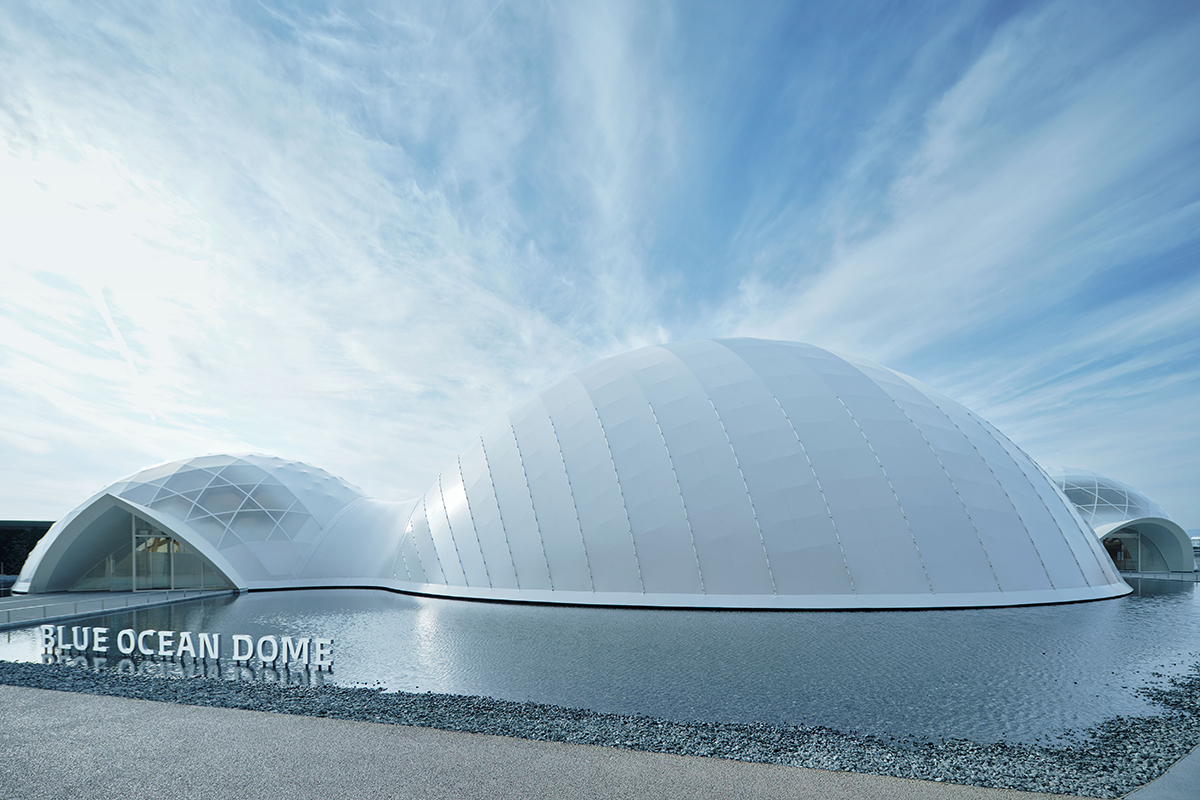
Sunami: The sea is a shared asset of mankind. It provides us with water, ecosystems and various substances that are the source of life, and has the function of regulating their circulation. The exhibition made visitors realize that the way we dispose of garbage into the ocean eventually comes around back to affect our lives.
Ban: I’m very reluctant to dispose of waste. The paper tubes we use as building materials are made from recycled paper, and they are collected and recycled after the shelters are dismantled. In the Noto Peninsula, where a major earthquake hit in 2024, the region’s distinctive Noto roof tiles have been passed down through generations. In this region, we have engaged in activities to recover old construction materials like roof tiles, pillars and beams from collapsed buildings so that they can be reused somewhere else.
Sunami: And let me also mention that the Blue Ocean Dome was a building designed to be reused.
Ban: The materials extracted after the dome was dismantled are set to be transported to Thailand, and the work is currently underway for this. Furthermore, the Centre Pompidou-Metz, annex for the Centre Pompidou in France, was designed by me and there’s a plan to build a structure at the facility that will use the materials from the dismantled dome. This structure will be used for school activities where students learn about marine pollution and other issues.
Sunami: Ban-san, your architecture shows that you are strongly interested in using unique materials in your architecture. You have used wood and paper, for example.
Ban: As soon as I first became an architect, I was interested in using familiar materials like wood and paper as building materials. But at the time, there was widespread belief that it’s safer to use sturdy materials like concrete, and so it was initially difficult to get my proposals accepted. Things began to change in the late 1980s, when awareness about environmental issues grew. That led to a paradigm shift, and wood and paper became a focus of attention as recyclable materials. Whether I am working on large structures or housing under disaster-relief projects, I usually try to use wood and paper materials that are easy to obtain and make sure they are reused after the buildings are dismantled.
Sunami: After the United Nations adopted the sustainable development goals at a U.N. summit in 2015, nations began to work under them as shared goals. But come to think of it, we are only four years away from the target date of 2030. Suppose the goals are not met by the deadline, the question is whether we should extend it or whether we need a new approach. Perhaps another paradigm shift is needed in the coming era.
Society of true happiness
From here on, what will be needed for reconstruction assistance and peace-building efforts?
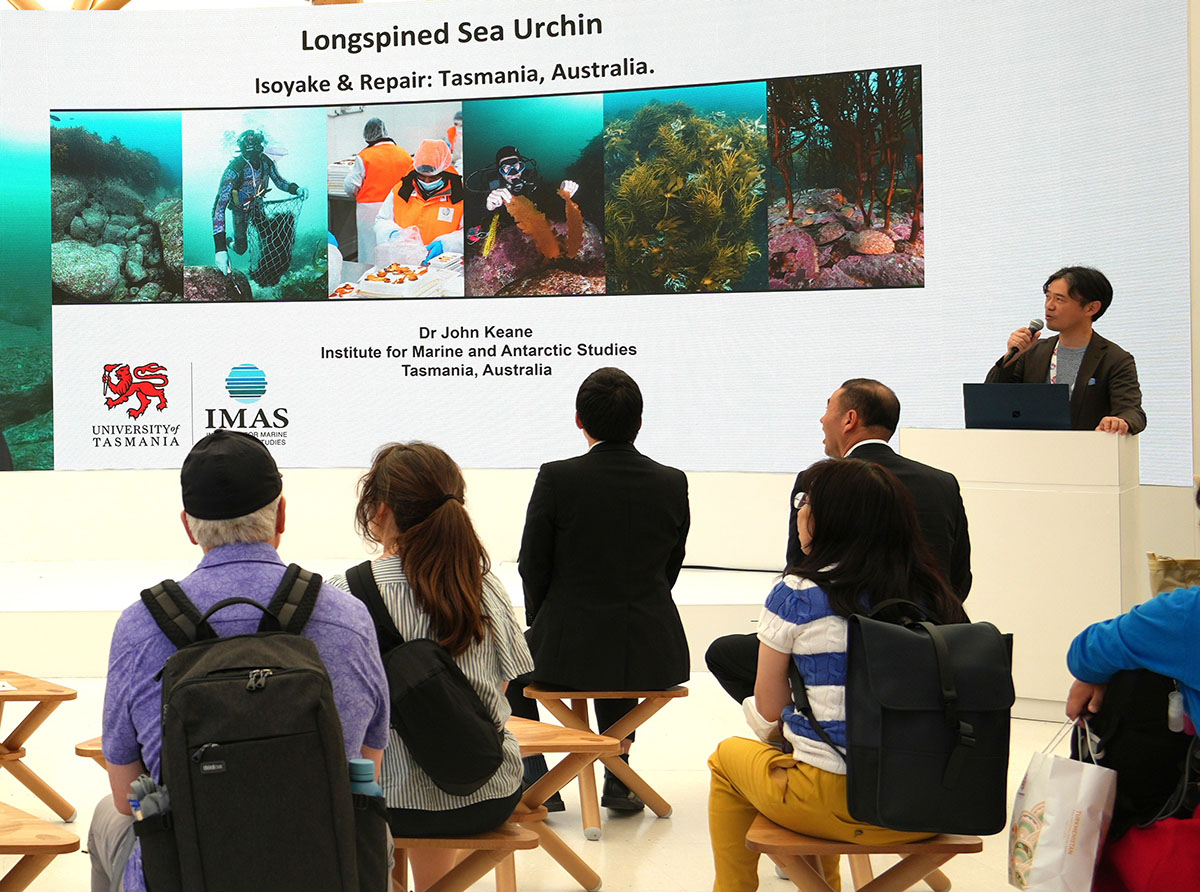
Sunami: Think tanks can now collect a huge amount of data from different parts of the world and share them instantly with a large number of people. However, the particularly important thing for us humans is to think about how we should interpret the data and how we should utilize them. For this reason, at our foundation, we have highly specialized personnel perform data analysis and utilize the findings in conducting our programs. Peace must be sustainable and permanent. If the peace that has been achieved is disrupted again, we need the kind of knowledge and experience that make it possible for us to respond quickly. However, these are not something you can accumulate in data or documents only. Rather, they must be passed down from person to person. So, we believe that one of our major missions is to support these efforts to share knowledge and experience.
Ban: Computers can be used as a tool to perform work, but I don’t think they contribute to the development of architecture. With AI, you may be able to use past examples to create buildings that are familiar-looking, but AI cannot generate something with originality or uniqueness. To this day, I draw my sketches by hand and manually cut paper to make models. That is because my gut feeling is that hand-drawing is connected to my heart, while a computer only connects to my brain.
Sunami: Suppose you want to create a world free of war, technology eventually might make it possible to disable use of weapons altogether. Then, with the help of AI, you may be able to build an efficient social system. However, each of us must ask ourselves whether we can live a happy life every day in that society and whether it is truly a society we wanted.
Ban: I teach at universities and have had opportunities to take students to disaster-stricken areas to do support work. And I realize that young Japanese today are not fascinated with foreign countries, and fewer students are studying abroad. I would call this an alarming situation. I believe people need to come into contact and interact with each other and get to know each other if we are to establish a common understanding for the goal of building a better world.
Sunami: In terms of regions, I am interested in countries of the Global South, including India, Southeast Asia, Latin America and Africa. Developed countries, like G7 countries, are declining in their clout over the global community, and emerging and developing countries are gaining power on their own. As a people that can embrace diverse values, Japan must work with these countries as equal partners to redesign the future of this planet. I believe that will help create the peaceful society that we seek.
Atsushi Sunami : President of the Sasakawa Peace Foundation
He currently serves also as the president of the Showa University of Music, special adviser to the president and guest professor at the National Graduate Institute for Policy Studies, guest professor at the Waseda University Research Organization for Nano & Life Innovation, and distinguished fellow of the Asia Pacific Foundation, Canada. He holds a Ph.D. in political science and a master’s in international affairs from Columbia University. After serving as a special adviser to Japan’s Cabinet Office, Sunami was appointed to other government posts, including chairperson of the Cabinet Office’s Okinawa Development Council. Sunami has served in his current position in the Sasakawa Peace Foundation since October 2020.
Shigeru Ban : Architect
He is a specially appointed professor at the Shibaura Institute of Technology and a member of the Japan Art Academy. He is known for developing innovative structures and construction methods for his architectural works, including the use of recycled paper as a building material. In 1995, he established the nonprofit organization Voluntary Architects’ Network (VAN), through which he has provided disaster relief around the world. His many honors include the Pritzker Architecture Prize (2014), the Princess of Asturias Award for Concord (2022), the Praemium Imperiale in the field of architecture (2024) and the American Institute of Architects Gold Medal (2026).
Visit our special 40th anniversary website.
Sasakawa Peace Foundation
The Sasakawa Peace Foundation promotes international understanding, exchange and cooperation. Created as a public-interest incorporated foundation, it addresses complex issues facing society in the 21st century and implements various initiatives and support activities addressing natural and social crises. Furthermore, it uses flexible ideas and methods unique to a private foundation to promote activities, proposals and exchanges that pursue new forms of governance for human society and also promotes collaboration between Japan and other countries at all levels. The foundation is working to help establish a new form of ocean governance, resolve diverse problems facing the planet and realize peace and safety for the world.


